

Spine Treatment
Say goodbye to pain and hello to a healthier lifestyle with our approach to chiropractic care.
What holds your spine in place are your muscles and ligaments. It makes no sense to adjust your spine and then not address a tight muscle that will just pull your spine out of alignment again. We address the muscles with state of the art soft tissue techniques as well as stretches and exercises to help you hold your alignment.

Exam
Your exam will not just focus on pain but also how your body is compensating due to spinal or extremity dysfunction.
Part of your exam will be your vital signs. If you are in pain due to misaligned spinal segments, they could be impacting your nervous system. This pressure and inflammation can result in elevated vitals signs. These have the potential to improve as your pain diminishes.

Electrical Stimulation
Electrical Stimulation is used to help reeducate muscle contraction from being in spasm to normal muscle tone. Muscle tone has an impact on your spinal alignment and the doctor’s ability to manipulate/adjust your spine. If your muscles are in spasm it is much more difficult to provide an adjustment. The muscles being more relaxed will then allow you hold proper alignment. Electrical stimulation has also been found through research to help with swelling in the injured area and thereby help with pain reduction.

Ultrasound
Therapeutic Ultrasound is often used to promote blood flow, and begin to relax muscles and address adhesions within soft tissues that might be preventing you from making progress.
Radial Pulsed Wave/ AKA Shockwave
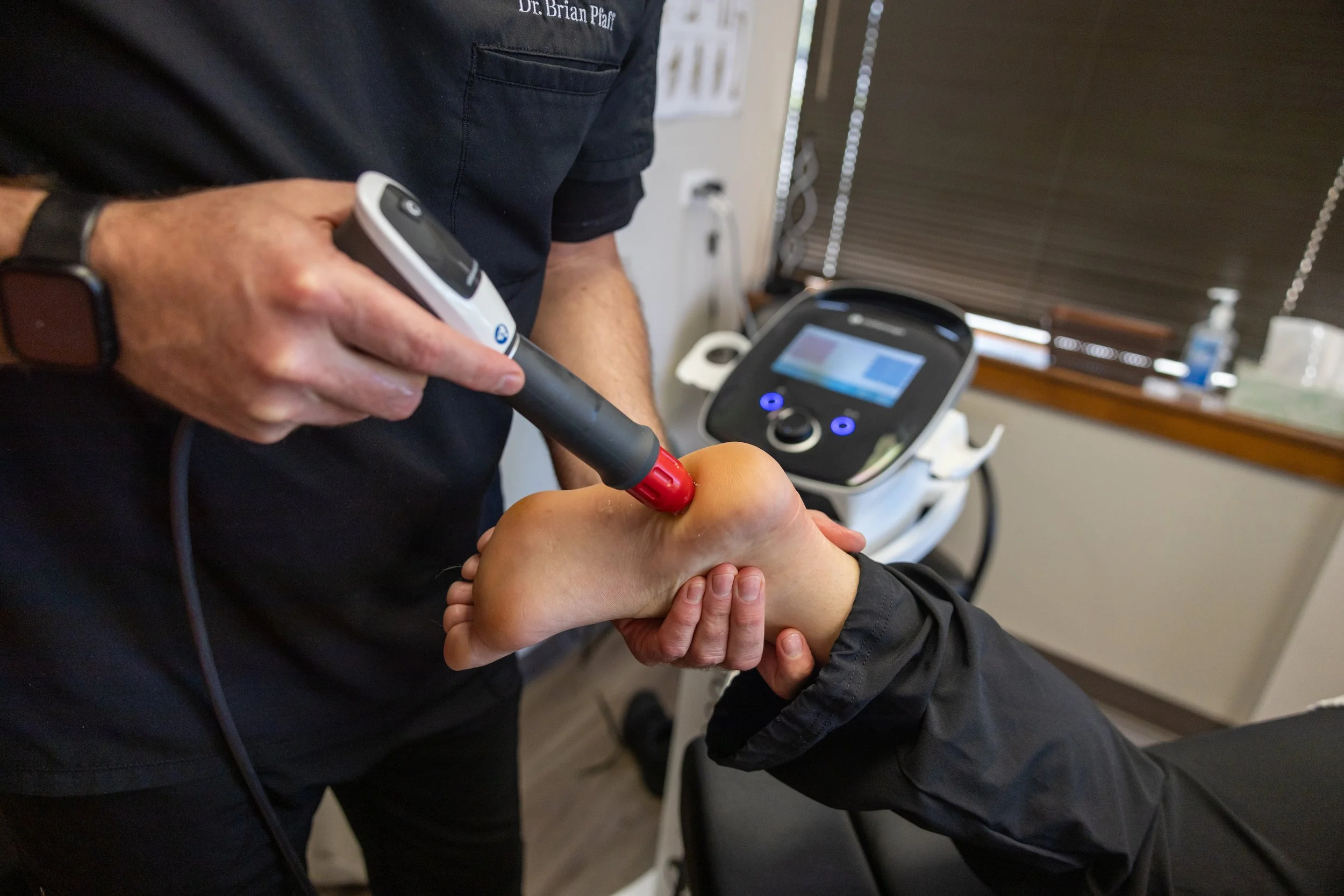
Radial pulse wave therapy, initially for kidney stones, has been modified for chronic pain with lower intensity. It uses a probe to emit sound waves into tissue, generating microbubbles that burst, disrupting scar tissue or adhesions and promoting normal tissue healing through a "shock" process. This method, using sound wave "shocks," not electrical, benefits conditions like plantar fasciitis, IT band syndrome, frozen shoulder, back pain, and elbow/wrist pain such as tennis/golfer's elbow.

Laser Therapy
Class IV laser in our office has a dual beam. These laser wavelengths must be very specific in order to elicit a healing response. Our laser works at 810 and 980 wave length to not only help reduce pain but also to simulate mitochondria to speed up the Krebs cycle (chemical process where you turn food into energy in the cell) and produce more ATP which is energy. This increased ATP output helps with energy for healing damaged tissue.

Hako-Med
Hako Med, invented by the pioneer of electrical stimulation, uniquely targets a body-produced chemical called cyclic adenosine monophosphate (cAMP)—with a lowercase "c". cAMP facilitates pain signal transmission and is depleted when exposed to 4000 Hz. Unlike typical electrical stimulation devices operating at 250 Hz, Hako Med functions at 4000 Hz. This enhances membrane permeability, boosting sodium and potassium channel function and promoting nerve healing.

Soft Tissue Techniques
Your care will include manual hands-on soft tissue work. The muscles around your spine are what hold your spinal bony segments in proper position. Soft tissue work can include, cupping and tool soft tissue scraping techniques to help eliminate muscle knots. These adhesions and muscle knots are what can prevent you from making a full recovery as it can limit full range of motion of the joint.

Adjustments
Adjustments of the spine and extremities can be done with a variety of techniques. This will include: Manual hands on joint manipulation. Thompson Drop Table technique. Activator technique. Impulse Electronic Adjustor technique. Toggle Recoil technique. Gonstead technique.

Decompression
Spinal decompression can be helpful when you have a disc between two vertebra that is either compressed or herniated/bulging (Think of the soft filling in an Oreo cookie). This can be done in both the neck and lower back. This machine will gently traction/decompress your neck or lower back to open up the disc spacing and provide relief to the nerves.

Exercise
Stretches and exercises will be given. This will help maintain your alignment and help speed your recovery by building strength to hold alignment. You will receive a text message from our office with a picture of each exercise prescribed and a description of how many times to perform each exercise.

Patient Education
Education regarding spinal anatomy, posture and fitness levels will also discussed. We want you to be educated about your complaint so you can make proper health decisions. It is important for patients to understand what needs to be addressed based on what we find in your exam and history.
Frequently Asked Questions
Are X-rays always needed?
We use St. Alphonsus Radiology across the street from our clinic if X-rays are needed. We can also order imaging at any other facility if you have one that you prefer. The need for X-rays is based on your history and exam.
Can you treat low back pain related to pregnancy?
Yes! Please discuss this with your OB doctor as well. Many women have found chiropractic care to be helpful with pregnancy-related lower back pain.